The Institute of Empathy
As Jake stepped off the escalator onto the top floor of the Seattle Art Museum, the electronic blips and wheezes welcomed him into again to the Institute of Empathy. Whenever he was downtown and had the time, he came here.
Entering the room, the familiar machine was churning colors into organized geometry as always. The art installation occupied an entire end wall of the exhibit room, wrapping around the walls and spreading across part of the floor as well. White lines painted on the black wall and on-step platform outlined the pipes and chambers of a machine. A set of overhead projectors shined images of unorganized color blotches traveling through the pipes and into rotating machinery that organized the colors into spinning oars or maybe feathers or something, Jake wasn’t sure. Colors coalesced into dots, almost like pebbles, that flowed into tubes connected to a central life-sized figure standing on one leg with hands together. Jake knew it was Vrksasana or tree pose, but as a kid raised Catholic he could not stop from seeing it as a prayer. Colorful pebbles also showered two sitting figures on either side of the standing figure, each in relaxed meditative poses with hands resting on their legs and turned upwards, open and receiving. Or was the machine extracting colors from the seated people? Were they instead giving? Again, Jake wasn’t sure. The projections morphed and changed as the machine spun up to full power. What had initially been a trickle of colors was creating not just a constant flow of colorful geometry but also images of faces wearing colorful helmets within the machinery.
“Gotcha!” A child jumped and stomped loudly on a colorful object projected onto a 10-foot-wide black circle in the middle of the museum floor in front of the machine and installation platform. The projection continued moving as though she were not there at all. “Hey! Come back here, boat!” The child pounced again, her hands slapping on the floor on top of the escaping shape. It still did not acknowledge the child. “Stop!” The child’s playful tone shifted to a screech, fun morphing to frustration. A man, black hair starting to gray on the sides, stepped into the circle and started walking on top of the colorful shape. “Look, kiddo! I’m on a boat,” he said, waddling with small steps as the projection moved. The kid squealed. “Daddy! Wait for me!” The kid then found another projection following behind her dad’s and jumped on. “Don’t fall in!” she said, stepping with focused care. “What’s down there if I fall?” her dad asked, waving his arms around as though he were losing his balance. The child slowed as she thought, then squealed and jumped forward when she realized her boat had moved forward without her. “It’s space,” she said, stepping along with the projection. “You’ll float forever.”
Jake was not sure if people were supposed to walk on the black circle, and in all his time coming here there seemed to be no consensus from other museum visitors. Most adults avoided stepping into the circle. There was no rope or laser-tripped alarm. There was no sign. Just a deep, dark spot on the floor with colorful blotches and indiscernible objects projected from overhead and moving in a slow orbit. Some visitors kept well clear of the circle, maintaining a comfortable bubble between the viewer and the art. Other viewers would stop at the edge of the circle, and then peer over the edge into the abyss. Children saw the circle as theirs, finally a piece of art in this stuffy museum they could touch and step on. Their parents were forced to decide how to handle it. Some chastised their kids, scolding them for stepping on art. “We talked about this,” or Jake’s favorite, “You know better.”
It honestly wasn’t clear what the artist, Saya Woolfalk, wanted. There’s a statement printed on the wall, welcoming visitors to ChimaTEK’s Institute of Empathy. “Three Empathics have moved into the Seattle Art Museum and established a virtual space where you can step outside your normal, routine self and improve your ability to understand others.” Is this an invitation to interact with the installation? Those seeking answers would not find them in the blocks of text.
The circle on the floor is just the warm-up, the real test happens on the ends of the machine flanking the three Empathics. Two unoccupied mats with colorful pebble fabric are on the floor. Above the mats are what appear to be helmets or masks with colorful decorations and faces. Even most people who decide that walking on the black circle is acceptable do not dare sit on the mats or try to put their heads into the helmets. Yet every once in a while, there is one.
Jake had once watched from his usual perch on a nearby bench as a younger woman read the information written on the wall. She was Black, wore a long color block dress, and had these white-framed flat-topped glasses that came to a point on each side beyond her face before swooping in a curve back down and toward her nose. After reading, she contemplated the machine from a safe distance. Several other museum visitors milled around as she set her bag and rain jacket on the ground, leaning them against the blank wall, and approached the machine platform. She removed her rain boots and placed them neatly on the floor with their heels against the wall, then stepped up onto the platform, her colorful thick socks bright against the black paint. She turned to face the three Empathics and sat down on the color-dotted mat with her legs crossed in the same meditative position as the two seated figures. Jake’s face flushed, heated blood flowing through his body as he watched her. Then he watched the reactions of the other viewers. One older couple grabbed each other lightly as if something dangerous were happening. Another man looked around to see if any museum staff were on their way to tell the woman to leave. Nobody said anything. Instead, she closed her eyes and took slow, deep breaths as the machine harvested colors from the top of her head and fed them into its cycling chambers.
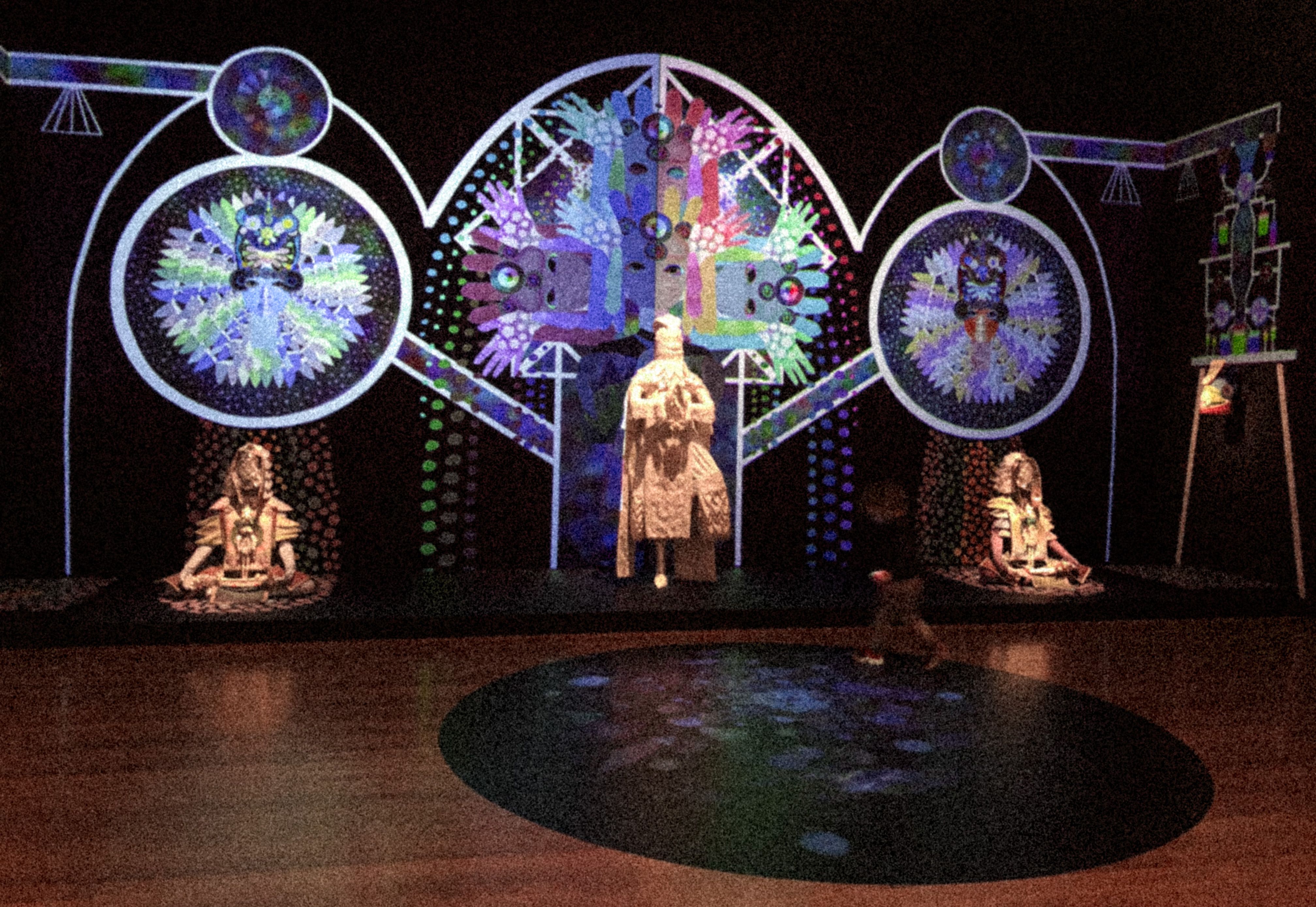
Lessons from the Institute of Empathy (2018)
Saya Woolfalk
Seattle Art Museum
- ← Previous
A little red book - Next →
Bankfaced bills